Minesweeper FAQ: Your Questions Answered
Anna | September 27, 2026
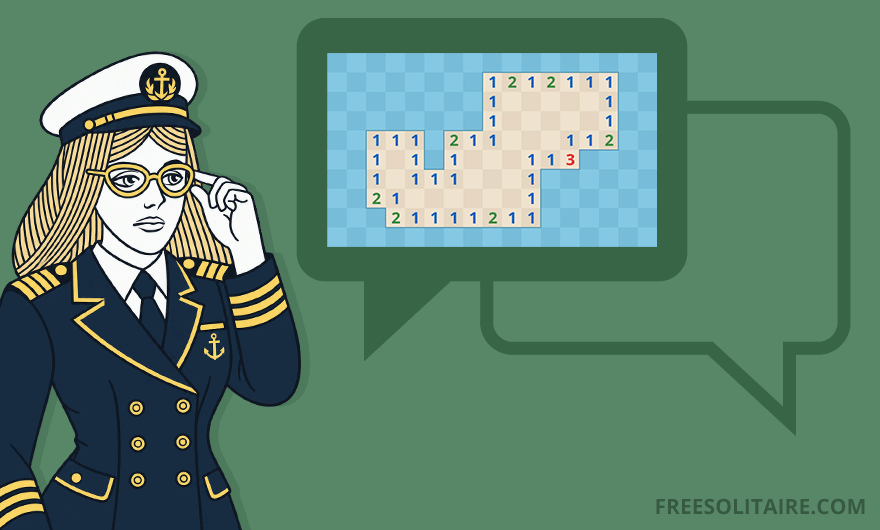
The questions we get most about Minesweeper, answered in one place. Less typing, more defusing.
How do you play Minesweeper?
In one sentence: uncover every square that doesn't hide a mine, using the numbers on the board as clues. Each number tells you how many mines touch that square. The full walkthrough, with pictures of our game and every way to control it, is in our Minesweeper rules guide. If you've never played, start there and come back here for the details.
How do I place a flag?
Right-click a square on desktop, or press and hold it on a phone. The flag button above the board works on both. All the controls, including the Ctrl-click trick for trackpads, are listed in the rules guide.
Can I play Minesweeper without a mouse?
Yes. On a touchscreen you tap to dig and long-press to flag. On a laptop trackpad, tap to dig and Ctrl+tap to flag, or use the shovel/flag switch so you never need a second button at all. What you can't do at the moment is move around the board with the arrow keys; Minesweeper is a pointing game at heart. The keyboard does get one job: press R or N for a new game.
Why won't the game let me place another flag?
Check the flags counter. Our game gives you exactly as many flags as there are mines, so when the counter hits 0 you've used them all. If there's clearly still a mine to mark, one of your earlier flags is on a safe square. Find it, remove it and the counter goes back to 1.
What do the numbers mean?
How many mines touch that square. A 2 means exactly two of the surrounding eight squares hide a mine; a blank means none, which is why blanks open up on their own. The rules guide walks through this on a real board.
Is Minesweeper luck or skill?
Mostly skill, with a pinch of luck. Reading the numbers is pure logic, and a good player can solve the vast majority of a board without ever guessing. Luck comes in two places: the very first click, and the occasional spot near the end where two squares are truly identical and no amount of reasoning can tell them apart. In the old Windows version that happened regularly. Here your first click is always safe, and the game picks a mine layout that can be finished by logic, so every board can be solved without a single guess. So if you lose, it was a hasty click rather than bad luck. Sorry.
Why is Minesweeper so hard?
Because one wrong click ends the game, and because a single number rarely tells you enough: you need two or three together, and seeing that quickly takes practice. Hard mode adds size on top; on desktop that means 99 mines on a 24 × 20 board. It gets a lot less scary once you stop guessing and start counting.
How do I get better at Minesweeper?
Stay on Easy until you can read a board at a glance, then step up a level. Our Minesweeper tips and strategies cover the habits that make the biggest difference: spotting forced mines, the 1-2-1 pattern, flagging only what you've proven and chording safely.
What happens when I hit a mine? Is there an undo?
The mine goes off, the other mines are revealed one after another and every flag that was sitting on a safe square is marked with a red cross. There is no undo and no second chance in Minesweeper, on purpose. Take a look at where the crossed flags are, because that's usually where the wrong assumption was, then press Try Again and the game deals you a new board at the same difficulty.
Where are my statistics, and why did they disappear?
Menu → Statistics shows games played, won and lost, win percentage, best and average time per level. The numbers live in your browser, not on our servers, so they vanish if you clear your browsing data, switch browsers or play in a private window. Walking away from an unfinished game is counted as played, so your win percentage stays honest.
What's the difference between this and Google Minesweeper?
Google's version is the small game that pops up when you search for "minesweeper," and it plays by the same rules, so everything on this page applies there too. Ours adds per-level statistics with your best and average times, shows your wrong flags at the end so you can learn from them and gives you a full page instead of a box in the search results.
What is the Minesweeper world record?
Top players clear Beginner in about a second, Intermediate in around seven seconds and Expert (99 mines) in just under half a minute, mostly without placing a single flag. A minute on Easy is a perfectly respectable start for the rest of us.
Is Minesweeper good for your brain?
It's a workout for it: a chain of small deductions under mild time pressure, keeping several numbers in your head at once. Whether it makes you "smarter" is a claim no puzzle game can honestly make, but as a ten-minute break that keeps your mind switched on, it's hard to beat.
When did Minesweeper come out, and who made it?
The Windows version was written by Microsoft programmers Curt Johnson and Robert Donner and released in 1990, with older ancestors going back to the 1970s. The whole story, Bill Gates anecdote included, is in our history of Minesweeper.
Question not on the list? Send it through our contact page and I'll add it. Now go clear a board!