History of Minesweeper: The Little Grid That Taught Us to Right-Click
Anna | September 16, 2026
Click. Click. Click… BOOM. If those three clicks just gave you a little shock, you already know Minesweeper. Right next to Solitaire, it was the other game quietly waiting on every Windows PC of the 1990s. One was relaxing, the other could ruin your afternoon with a single wrong click. And yet we kept coming back for more. Never played it? A grid of squares hides a bunch of mines, the numbers tell you how many are hiding next door and one wrong click ends the game (our Minesweeper tutorial explains the rest). But where did that gray grid full of hidden mines actually come from?
A Family Tree Older Than Windows
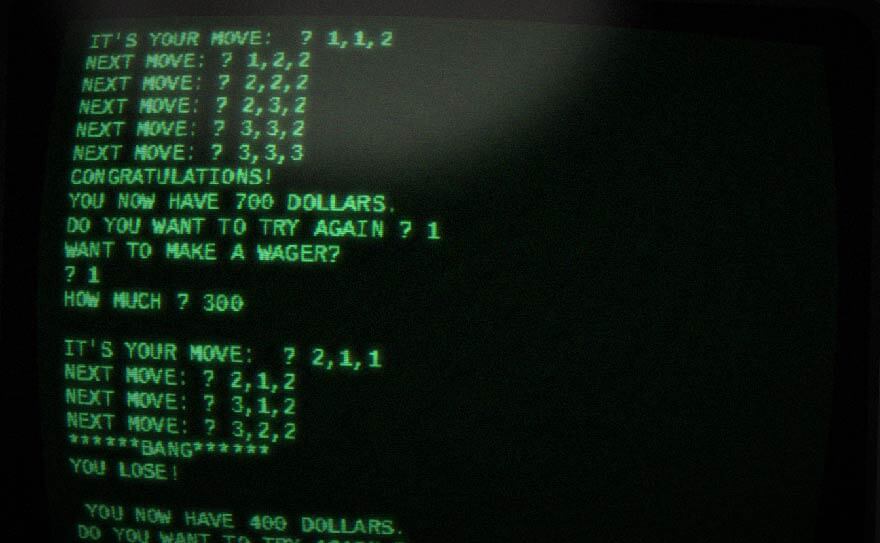
Let’s clear one thing up first: Microsoft didn’t invent Minesweeper. The oldest known ancestor is a game called “Cube,” written by programmer Jerimac Ratliff all the way back in 1973 in BASIC, long before computers had screens with graphics. There was no grid to click and no number clues at all. You typed coordinates to move through a 3 by 3 by 3 cube with five hidden mines, and before each game you could bet money on whether you would make it to the other side. Hit a mine and the screen simply printed “BANG… YOU LOSE!” Not much logic involved, but the seed was planted: cross a field of hidden mines without stepping on one.
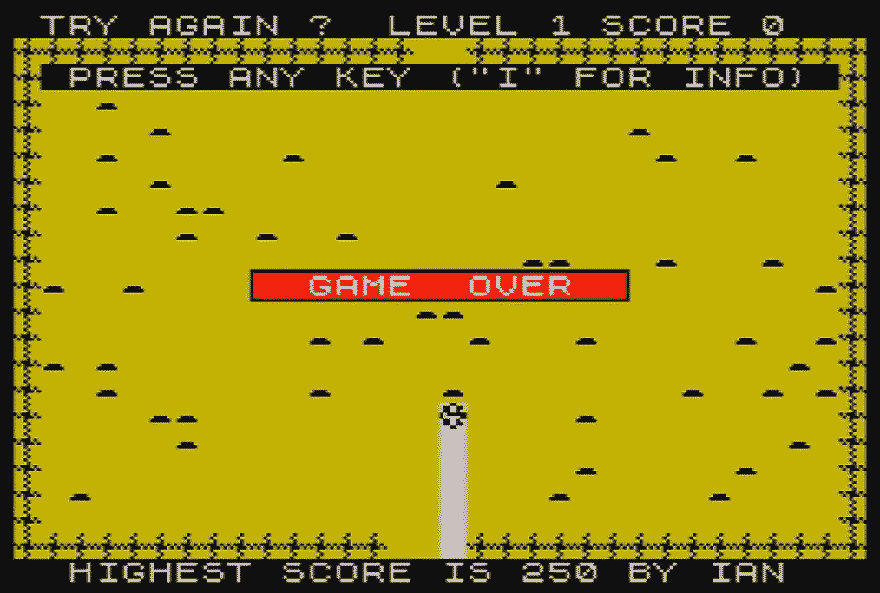
One of the first versions you could actually buy appeared in 1983, when Ian Andrew developed the ZX Spectrum game “Mined-Out.” For £4.95 (pocket money, even back then) you guided a little character through a minefield, level after level, to rescue a worm called Bill. It sold so well that Andrew gave up his other business and started a software company with the profits. He has also said many times that Microsoft copied his idea. Then in 1985 came “Relentless Logic” for MS-DOS, where you played a marine crossing a minefield to deliver a message, and the grid and number clues looked a lot like what we know today. Interestingly, the man who wrote the Microsoft version says he got the idea from another game, but insists it wasn’t Mined-Out. Who inspired whom? Even today, nobody agrees. What everyone does agree on is that the Windows version is the one that made it famous.
Two Programmers and a Side Project
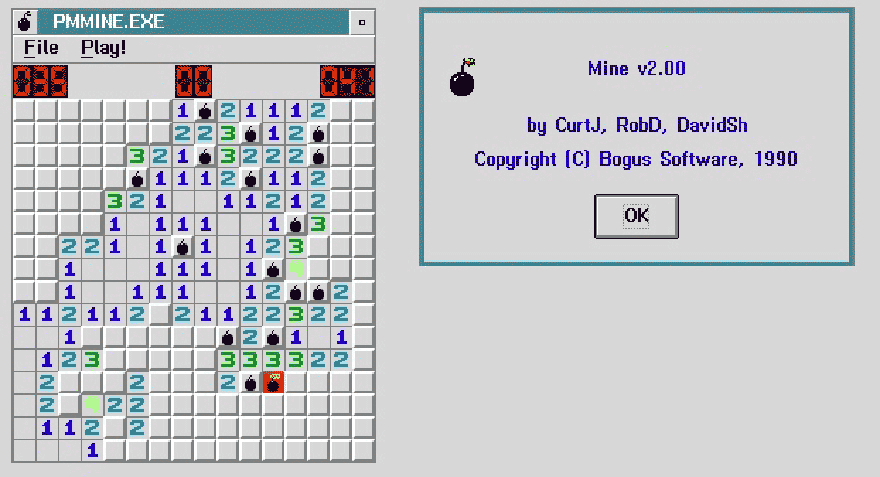
Here’s the part that sounds familiar. In 1989, Curt Johnson joined Microsoft and started working on a debugging tool for OS/2, the operating system Microsoft was developing together with IBM. To learn how to use the graphics system, he wrote a game in his spare time called “PM Mine.” MS Paint was still limited to monochrome, so he even built his own little drawing tool to add some color to the mines. Early versions even had hidden coins: find one and you could step on a mine without losing. That feature was left out of the Windows release. His colleague Robert Donner, who also joined Microsoft in 1989, liked it so much that he polished it up and, once version 3.0 of Windows was released in May 1990, rewrote it and called it “Win Mine.” A third colleague, David Shulman, gets a credit for testing, which probably means he lost a lot of games so we wouldn’t have to. Sound like Wes Cherry and his Solitaire? It is pretty much the same story, just with mines instead of cards.
Now You Can Use Windows to Goof Off
Microsoft was looking for games to show off its shiny new Windows 3.0, so employees were asked to hand in the programs they had built for fun. And that led to the Windows Entertainment Pack, released on October 8, 1990, costing $39.95. Minesweeper quickly became the standout game in the pack. Microsoft sold the whole thing with one line: “Now you can use the incredible power of Windows 3.0 to goof off.” One computer magazine called it the most addictive game the reviewer had seen in years and claimed it was worth the entire price by itself. Microsoft clearly agreed. Two years later, in 1992, Windows 3.1 came with Minesweeper, taking the place of Reversi. From then on, it appeared on hundreds of millions of computers and stayed there, almost unchanged, all the way through Windows 7.
The Accidental Mouse Trainer
Nobody planned it this way, but Minesweeper turned out to be the perfect mouse trainer. Most people in 1990 had barely touched a mouse, let alone the second button on it. Left-click to reveal a square, right-click to plant a flag. Millions of office workers learned to use both mouse buttons quickly and accurately without even realizing they were practicing. Not bad for a side project.
Bill Gates Had a Problem
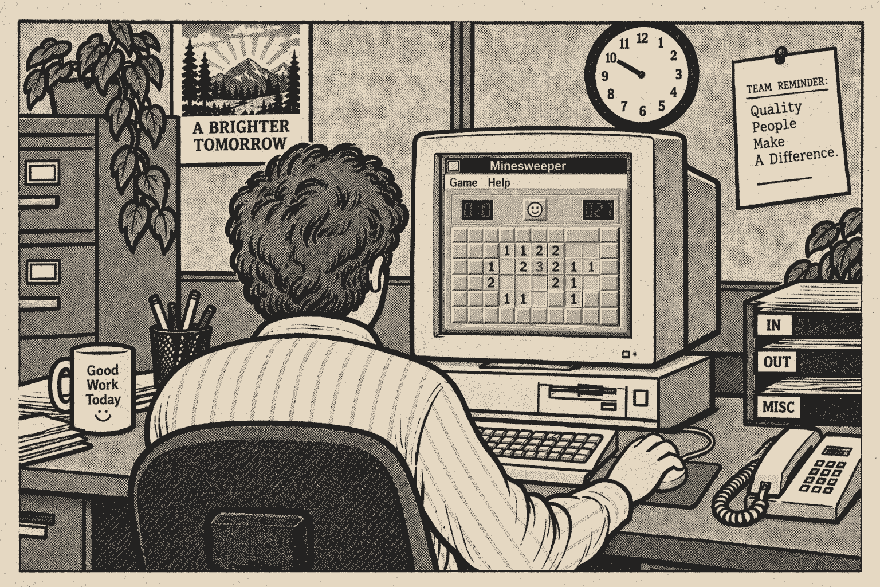
Now, for the best part… the biggest Minesweeper addict at Microsoft was the boss himself. Bill Gates loved the game so much that he had it removed from his own PC to get some work done. Did that stop him? Of course not. He simply walked into the office of Microsoft’s president, Mike Hallman, after hours and played it there. One Sunday, an email went around: Bill had set a new record on the Beginner level, and it was on the machine in the president’s office if anyone wanted to check. So staff went over at seven in the evening to see for themselves. His girlfriend at the time, Melinda, later asked the team to please stop telling Bill about new records, because he had more important decisions to make. But how do you stop a boss who wants to win? A product manager found a way: he used a macro to click through fresh games automatically until the computer produced a record no human could ever beat. Bill’s reply says it all: he wondered how people can keep their dignity when computers do the important stuff better than they do.
Banned, Renamed and Mathematically Impossible
Not everyone liked the idea of turning landmines into a game. Around 2000, Italian activist Sergio Chiodo launched a campaign to get Winmine banned. He wanted Microsoft to change the mines to flowers, and surprisingly, Microsoft listened. Italian versions of Windows later offered “Prato Fiorito,” which means “Field of Flowers,” and Windows Vista eventually made the flower version available to everyone. Around the same time, mathematician Richard Kaye showed that a version of Minesweeper is NP-complete. So if Expert mode gives you trouble, there is at least some science behind it.
Still Sweeping After All These Years
When Windows 8 arrived, Microsoft finally stopped pre-installing Minesweeper and moved it to its app store, complete with daily challenges and ads. Many players weren’t happy and went looking elsewhere, which is why you’ll find so many copies of the game online today. Even Google joined in. Type “minesweeper” into Google and a playable version pops up right on the results page, with cheerful green tiles, three difficulty levels and a little sound that climbs in pitch the higher the number you click. Google’s version also tries to hand out boards that can be solved by logic alone, so you’re not stuck with a 50/50 guess at the end. Purists miss the beige, but for millions of people it’s now the first Minesweeper they ever play. There’s even a competitive scene with world rankings, where the fastest players clear the Expert board in under 30 seconds. Yes, seconds. Most of us need that long just to find a safe first click.
More than 35 years after two colleagues swapped some code for fun, that little gray grid still has us holding our breath before every click. Not bad for a game that started as a way to learn a graphics system. In the mood for a calmer kind of challenge? You can always play a game of free Solitaire right here, or pick Freecell, Spider or one of our other card games. No mines included.