The Story of Hearts, From Card Tables to Clicks and Taps
Anna | February 9, 2026
The Hearts game looks easy at first glance. You follow suit, avoid tricks and start to fear a few cards more than anything else. But behind that clean rule set sits a long path. Hearts began as a real-life card game played in living rooms and cafés, then settled into formal rules and finally became a worldwide favorite once it landed on computers and later on the web.
Before Hearts had a name, people already loved not winning
Most trick-taking games reward you for capturing tricks. Hearts flips that idea. The fun comes from dodging, offloading trouble onto someone else and watching everything fall apart because one card went the wrong way. That way of thinking has deep roots. Some historians link Hearts to older European card games like Reversis, first recorded in France in 1601 and later popular around 1750 in Spain. In those early games, players could lose points for winning tricks or picking up certain cards, which lines up closely with the feeling that defines Hearts.
Hearts shows up in America in the 1880s
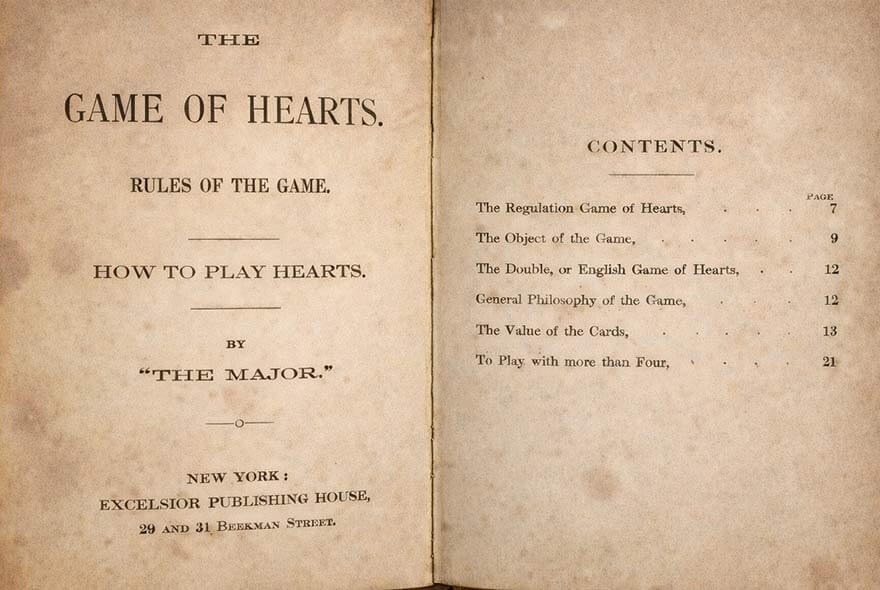
One of the earliest printed rules for Hearts in the United States appears in The Game of Hearts (1886) by Barnet Phillips (“The Major”). It describes Hearts as a fairly new game that had only been played there for a few years, which places its rise in the early 1880s. Still, the basics were already in place. There were no trumps, players followed suit and the goal was to steer clear of hearts. The shape of the game was already strong and it barely changed over the next 100 years. The Standard Hoyle (1887) soon repeated and helped standardize those rules.
The Queen of Spades enters the room
When most people say “Hearts” today, they are often thinking of a specific version, the one where the Queen of Spades carries a huge penalty. That twist comes from a variant known as Black Lady. Early rules for Black Lady appeared in the early 1900s, first documented in R. F. Foster’s Foster’s Complete Hoyle (1909) and the idea stuck fast. Taking hearts was bad enough, but taking the Queen of Spades could destroy a round. The game now had a villain and that one card could change everything in an instant.
The Hearts family kept evolving on the other side of the ocean too. British versions like Black Maria added more penalty cards and unique scoring rules. The core remained the same, but the pace and risk shifted just enough to give each variant its own flavor.
Windows turned Hearts into a global habit
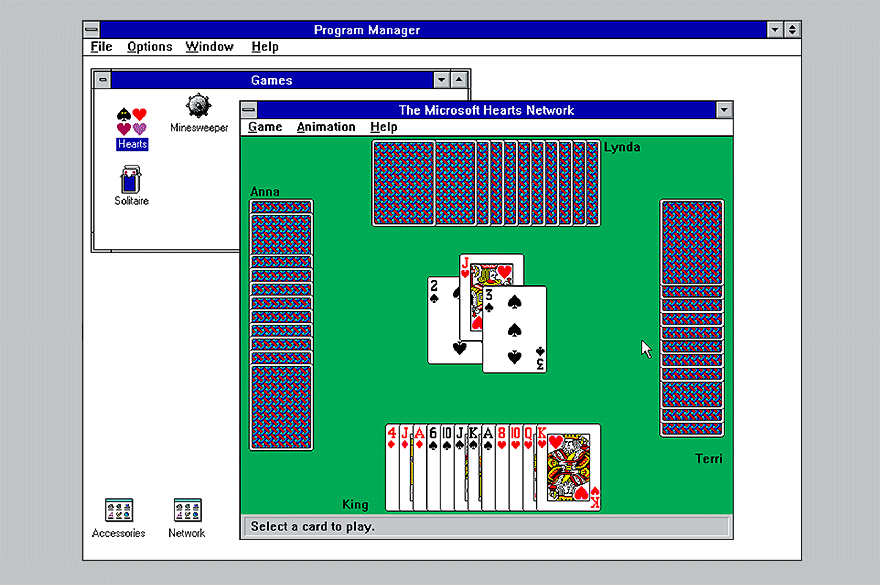
Hearts might have stayed a quiet favorite if it had only lived on as a physical card game. What changed everything was Microsoft. When Windows for Workgroups 3.1 became available worldwide on October 27, 1992, it included Hearts and the game suddenly took off. Microsoft used it to show how networking worked, letting people play multiplayer through NetDDE, a Windows feature that let programs share data over a local network. That is why the title bar of the game said “The Microsoft Hearts Network.”
Millions of people found the game just because it was already on their computer. It sat quietly in the Games folder and became part of everyday Windows life. Hearts stayed there all the way through Windows 7, released October 22, 2009, before the classic built-in games stopped being included by default with Windows 8, released October 26, 2012.
There was another change that shaped how people played. Microsoft used the Black Lady rules, so the Queen of Spades was part of the penalty system. Later versions even changed the name to Internet Hearts, and it appeared in Windows Me and Windows XP, but in XP the original network play was removed. That Windows ruleset ended up becoming the one most people learned, even if they never saw the older style where only hearts counted.
The internet era made Hearts social again
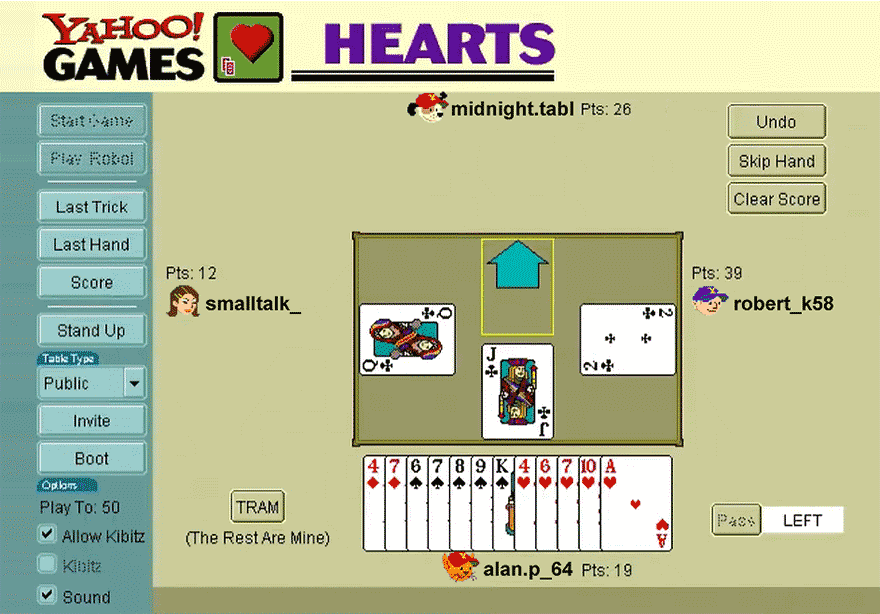
The next big shift had nothing to do with rules. It was about where people played. Yahoo! Games launched in 1998 and quickly turned into a home for casual online play. Card games were no longer limited to family tables. They became a way to meet strangers, chat and jump into quick games at any hour. That era came and went and Yahoo Games shut down in 2016, but it helped define what online Hearts would look like.
Hearts today, fast matches, smart bots and mobile habits
Today you can play Hearts in a browser or on your phone. Rounds are fast, the AI bots are better than ever and you can jump into another match without waiting. The pace is different from a long evening at the table, but the tension is the same. You still think you have it under control, then one trick turns the game upside down. That is Hearts.